The vpn extension vs vpn app question sounds like a preference and is really a question about scope. A browser extension protects what the browser sends. A desktop or phone app protects everything the device sends. Both can carry the same provider’s name and the same subscription, which is why people install one, assume they are covered, and are surprised later.
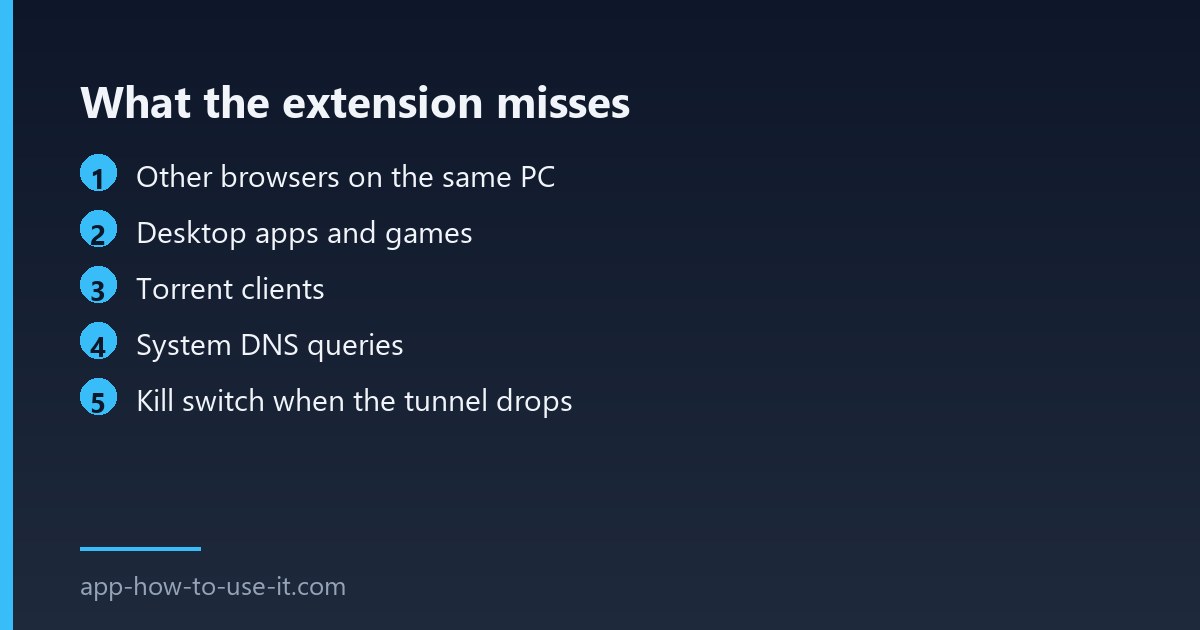
VPN extension vs VPN app in one table
| Browser extension | Full application | |
|---|---|---|
| Browser tabs | Protected | Protected |
| Other browsers on the same PC | Not protected | Protected |
| Desktop apps, games, email clients | Not protected | Protected |
| Torrent clients | Not protected | Protected |
| System DNS queries | Usually not | Yes |
| Kill switch if the tunnel drops | Rare | Common |
| Speed cost | Lower | Higher |
| Setup effort | Seconds | An install |
What an extension really is
Most browser VPNs are encrypted proxies rather than full tunnels. The browser is told to send its requests through a remote server, and it does. That is genuinely useful — the sites you visit see the proxy’s address instead of yours, and traffic on a shared network is encrypted between you and that server.
What it does not do is touch anything outside that browser window. A mail client checking messages, a game launcher updating itself and a torrent client all continue on your normal connection while the extension icon sits there looking green.
The leak worth knowing about
Browsers include WebRTC for calls and live media, and it can reveal local network addresses directly to a site, bypassing a proxy. Serious extensions ship a setting to block that; if the one you use does not mention WebRTC at all, assume it is not handled. A full application avoids the problem differently, by moving the whole network path rather than asking the browser to cooperate.
When the extension is the right choice
- You want one site to see a different country, and nothing else to change.
- You are on café Wi-Fi and only browsing.
- You need the speed, and the traffic that matters is all in the browser.
- You are on a work machine where you cannot install software — but check the rules before you do this.
When only the app will do
If your reason for using a VPN is privacy from your provider, or protecting traffic that is not browsing, the extension is not a smaller version of the app — it is a different tool. Torrents, backups, cloud sync, console traffic and anything running in the background need the device-wide tunnel. So does any situation where a dropped connection must cut the traffic rather than quietly fall back to the open line.
Running both at once is not usually a good idea. Two tunnels stacked on the same traffic cost speed for no extra protection, and providers often warn against it in their own documentation.
How to check what yours is actually doing
You do not have to take either one on trust. Turn the tool on, then load a site that reports your address and note what it shows. Now check the same thing from something outside the browser — a command prompt, or any desktop app that displays your connection. If the browser reports one country and the system reports another, you are running a browser-only tool, whatever its name suggests.
Repeat the test after a deliberate interruption: disconnect Wi-Fi for a few seconds and reconnect. An application with a kill switch will block traffic until the tunnel is back. An extension usually reconnects quietly, and anything that loaded during those seconds went out unprotected.
Is a free browser extension safe to use?
It depends entirely on who publishes it. An extension can read the pages you visit, so the trust you extend is larger than the feature suggests. Prefer extensions from providers with a paid product and a published privacy policy, and treat an anonymous free one with the caution you would give any unknown proxy. Our guide to free VPN extensions for Chrome goes through what to check.
How is this different from a VPS?
A VPS is a server you rent and manage; a VPN is a service that routes your traffic. People sometimes use one to build the other, which is where the confusion starts. We covered the distinction separately in VPS vs VPN.
The short version of vpn extension vs vpn app: pick the extension when the browser is the whole story and speed matters, and the application when the reason you want a VPN extends past the browser window. Knowing which one you installed is the part that actually protects you.